


David Evans: A long way forward
by Rupert Guinness
From Olympic near miss to gravel world beater, David Evans' story is one of endurance, reinvention and relentless forward motion. Once among Australia’s finest distance runners, Evans found a second elite sporting life on the bike after injury closed one door and opened another. Now 56, still racing at the highest domestic level and winning on the world stage, he balances an international career in the cycling industry with a competitive drive that has not dimmed in decades. Rupert Guinness sat down with Dave to trace a life shaped by discipline, resilience and a refusal to stand still, whether on the road, the track or the gravel.
When David Evans first thought he had reached the limits of his sporting career; it was during his years as an elite Australian runner, rather than the elite bicycle racer he is today.
Before the Easts Cycling club member started racing bikes in the 2000s, he was one of Australia’s top runners, from 5km to half marathon distance in road, 1500m to 10k in track and cross country.
Evans’ athletics career, honed by discipline, was highlighted with much success, but also defined by near-misses, foremost being his 1992 Olympic dream that fell a whisker shy of becoming reality. However, he still featured on some of the biggest podiums in Australian athletics, including Sydney’s City2Surf and the 1996 Gold Coast Half Marathon before calf muscle injuries led to the sliding door moment of his transition from elite runner to cyclist.
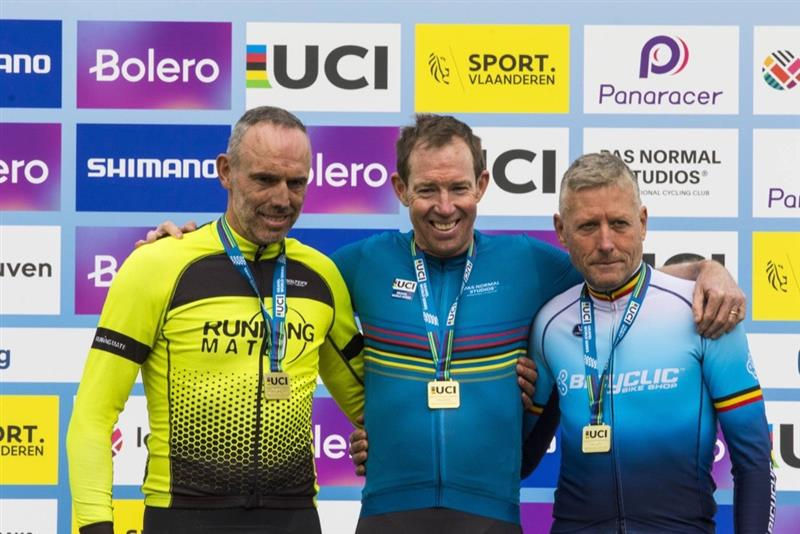
Today, Evans, 56, is embarking on his 25th year in the top grade of cycling in Australia. Add to that, he is showing little sign of easing up after a year that culminated with his naming last December as Easts Cycling’s 2025 Male Racer of the Year. The 2025 season included a win in the UCI ‘Flanders Legacy Gravel’ race in Leuven, Belgium, following the disappointment of the UCI World Gravel Championships in The Netherlands where he was well placed until a puncture ruined his chances, and his win in the Australian Road Masters 6 Championships.
The balancing act of life
It is remarkable that Evans still achieves such success despite the demands of his professional career that began in sports sales at New Corporation in 1994 while he was an Australian Institute of Sport (AIS) athlete, then continued at eBay and other roles and now for the last 14 years at SRAM where he is Sales Director for their APAC (Asia Pacific) operation.
That experience has taught him the importance of time management and balance in life.
“I was at the AIS, but I was also working at News Corp at the same time,” Evans says. “That set the tone early. I’ve always had to make things fit around work, not the other way around.”
Evans has continued with same approach while at SRAM, where cycling is both his profession and passion. “I work from home mostly, but I’m in Melbourne regularly, and I travel overseas a fair bit,” he says.
“Wherever I go, the bike comes with me. That’s just how it is.”
Rather than seeing work and racing as competing priorities, Evans views them as complementary. “Work gives you structure, and cycling keeps you grounded,” he says.
“A lot of what I do is also about listening. I’m talking to shops, distributors, riders — feeding back what’s happening in the real world.
“If something works brilliantly or if something doesn’t, that information needs to get back to the engineers.
“I also get to ride stuff that hasn’t been announced yet. That’s not just a perk. It’s part of the job. You need to understand how equipment behaves when it’s being pushed.
“I’ll race on it, train on it, travel with it. If something survives that, it’s in pretty good shape.
“Engineers are incredible, but there’s no substitute for riding. You feel things straight away — shifting under load, braking in the wet, how it holds up after hours on rough roads.”
And of course, life balance would not exist without family - his wife Tania, a former middle- distance runner he met at athletics meet and with whom he lives in Birchgrove, and their sons Josh and George, who are in their mid-20s and shaped by the same sporting environment.
Josh has even followed his father onto the bike and now races alongside him at Heffron Park in A grade. Whereas George has taken a different path by working and living in New York. However, as Evans says: “They’ve both grown up around sport. It’s just part of who we are.”
One of Australia's best runners
Evans was one of Australia’s most accomplished distance runners. His performances at the City2Surf, Australia’s most iconic road race, remain among the best recorded today.
In 1996, he was second to South African John Morapedi in 41 mins 5 secs for the 14km course from the CBD to Bondi Beach, beating 1996 Gold Coast Marathon winner Darren Wilson who was third. His time, then fourth fastest all-time, is still the 22nd fastest today.
That result was no outlier. He was third in 1991, fourth in 1996 and third in 1997. He was also 1996 and 1997 Australian half-marathon champion and represented Australia in two World Cross Country Championships and won silver in the 5,000m at the 1991 World Student Games.
But Evans’ running career is not defined by medals alone. The margins between them and their impact on his running career also left an imprint. The most crucial margin was the 300ths of a second difference between him making the 1992 Australian Olympic Games team for the 5000m and not based on accumulative performances over a series of selection races.
Evans was pipped for the spot by running icon Andrew Lloyd who won the 5000m national title race that year from another athletics icon, Pat Carroll. For Evans, in the frame for challenging for selection going into the race, it was the wrong day for a “poor race.”
Evans clearly had the ability to be an Olympian, and he showed that again in the years to come until calf muscle injuries steered him to a life in cycling, on and off the bike.

The sliding doors
Fortunately for Evans, before the bike became his raison d’être, cycling had always been in the background. Whenever he was injured while running, he would ride with Frank Conceicao and the Easts Cycling group. What began as a form of rehabilitation became a platform of revelation once his elite running days came to an end.
But before they did, Evans still managed to include both sports at an elite level. In 2002, he travelled to the US to race in the Duathlon World Championships, finishing an impressive 20th in the professional race, but that would be the last event in which he ran competitively.
But by then cycling racing, especially at Heffron Park on Tuesday nights had dug deep. He has since been racing there for 25 consecutive seasons, and proudly without missing a year.
“It’s my home,” he says. “I love being part of A grade. I call it my $20 training session.”
Would you believe it? He is riding faster than ever. His six quickest races there have all come in the past two years. “The level has never dropped,” he says. “If anything, it’s higher.”

Gravel, heartbreak and redemption
But cycling has not all been about Heffron Park for Evans. As 2025 showed, gravel racing has become a source of inspiration too. The centrepiece of his 2025 season was the Gravel World Championships, for which he trained specifically for 12 weeks under the coaching of training partner and close mate, Anthony ‘Shippy’ Shippard with a tailored preparation, a departure from his usual approach of getting race fit by chasing faster wheels.
Gravel racing, Evans believes, suits him perfectly with its need for sustained power, climbing, race craft, and patience … strengths that once made him a world-class runner.
He planned his training around work commitments at SRAM. His wife, Tania, sacrificed a “conventional holiday” to join him in Europe, where they lived and trained with fellow racers, including fellow Easts Cycling rider Brad Mills, in Maastricht in the Netherlands.
The World Championship race itself was going perfectly; that is, until it wasn’t when he punctured in the lead group of around 15 riders in his 55-60 age category. Despite meticulous preparation (correct tyres, sealant, careful equipment choices) it all unravelled in moments.
Ironically, the puncture came on champagne gravel. Sealant sprayed everywhere. Evans plugged the tyre three times without success. Eventually, a spectator handed him a huge mountain-bike plug that he says was “like a liquorice stick,” but at least it finally worked.
He lost five minutes and all hope of the top place finish he believed he had in him; but rather than throw the towel in, he recalibrated. “I just rode it like a hard training session,” he says.
The sting was softened by a telling statistic: his finishing time was effectively identical to the winning time in his age group. The form was there. It was just that the result was not.
Moving on...fast
That night, Evans parked the disappointment with a few gin and tonics, a good dinner, and a
conscious decision to move forward. “I can’t change it … What’s next?” he asked himself.
The answer was unexpected. While in Amsterdam afterwards, Tania, spotted the notice of a race in Leuven, Belgium, the Flanders Legacy Gravel race, also a 2026 Gravel Worlds qualifier. She suggested he race it, and he barely drew breath before signing up for it.
However, Evans did not over play his final preparation for the UCI event. He trained lightly. Ate well. Rested. Arrived at the start feeling fresh. He didn’t even pre-ride the course.
Once under way, he settled in well. Then midway through lap two, he rode clear with a rider who had punctured from the elite field. Soon after, he was alone. “I never saw anyone again.”
Evans won by five minutes from second place and eight minutes from third; both Belgians racing on home soil. He also rode through the 50–55 age group and beat them.
“It was probably the best race I’ve ever had,” Evans says.
Built for the long haul
Evans’ ability to rebound is no accident. He has trained every day since he was 13.
He travels with a bike. He trains around 14 hours a week. He rarely changes his diet, simply dropping alcohol when necessary. He describes himself as perpetually “80 per cent ready”.
“It’s just part of who I am. Give me six weeks and I can be race-ready,” Evans says.
One of Evans’ great joys now is racing A grade at Heffron Park alongside his son Josh.
“It’s the biggest buzz,” he says, but then adding: “I worry about him, not myself.”
Evans also likes to see other younger or less experienced riders develop as racers at Heffron Park which is one of the most technically demanding criterium courses in Australia.
For riders starting out at Heffron Park, Evans advises patience and self-preservation.
“Watch first. Listen. Learn,” he says. “Don’t just jump in thinking you need to prove something.”
After more than two decades racing the circuit, Evans believes understanding the flow of the
race is more important to performance than once’s raw strength.
“You learn where to corner, where to put the power down, where to back off,” he says. “And the wind changes everything. If you don’t respect that, you get found out quickly.”
He is also frank about the risks that come with Heffron’s tight, imperfect surface; from the inherent risks of crashes to how the heightened state of mind of racers racing full speed in tight bunches on such a technically challenging circuit can lead to fiery outbursts.
“It’s dangerous,” Evans says.
“People can get sharp in the heat of the moment. “That’s just racing.” But experience, he adds, teaches restraint. “I’ll happily give up a wheel. I don’t need to be in every gap.”
That approach by him, Evans says, has evolved over time. “When you’re younger, you think you must fight for everything. Now I know when to let it go,” he says whimsically.
For Evans, longevity matters more than bravado today. “I like my skin where it is,” he says.
“You roll off the track and it’s forgotten anyway. Turning up again next week is the win.”

Still tapping into inspiration
When it comes to inspiration, Evans still looks to resilience and cites the likes of Phil Anderson, Greg LeMond, Cadel Evans, Richie Porte, and Simon Clarke as examples.
“Phil Anderson was my first cycling hero,” Evans says. “Watching an Australian [in the 1980s] go to Europe and not just survive but race at the front — that mattered. It showed it was possible.”
LeMond, who first won the Tour de France in 1986, left a similar impression; and not just for his success but for the way he came back from being accidentally shot in 1987 while hunting.
“LeMond went through things that would’ve ended most careers,” Evans says. “To return from that and again win [the Tour in 1989 and 1990] — that’s resilience.”
“Cadel just kept turning up. He took the hits, he wore the pressure, and he kept coming back.
Winning the Tour [in 2011] wasn’t just talent — it was persistence.”
Porte, Evans says, “Copped so much … Crashes, bad luck, criticism — and he still delivered at the highest level [with wins and in 2020, third place in the Tour]. That takes real strength.”
Whereas Evans says Clarke, whose career includes a 2022 Tour stage win, is “Not the loudest guy, but he just keeps working. He finds a way to make something happen. I love that.”
“Anyone can go well when things are easy. What I admire [about them all] is the ability to keep going when they’re not.”
But the same advice underpins everything Evans has learned, even when missing Olympic selection as a runner in 1992. As he says today:
“Never look backwards … Always forward.”
.jpg)
Early 1990s: 1500m Championships
.jpg)
The Easts jersey back in the day.
.jpg)
Victory: 2025 Belgium Legacy gravel race